
Creatine is no longer viewed as a supplement only for male bodybuilders. In 2026, it has become one of the most discussed wellness tools for women interested in strength, healthy ageing, exercise performance and possibly brain health. But popularity can blur the line between proven benefits and hopeful marketing. This evidence-informed guide explains what creatine does, where the research is strongest, how women can use it practically, and when professional advice matters.
Quick answer: creatine monohydrate is the best-studied form. For most healthy adults who choose to use it, a consistent daily dose of 3–5 grams is the simplest approach. Its clearest benefits appear when it is combined with resistance training. It is not a replacement for exercise, adequate protein, sleep or medical care.
Why Is Creatine Trending Among Women?
Creatine has been used in sports nutrition for decades, yet the conversation has changed. Women are now asking broader questions: Can it help preserve muscle during perimenopause and menopause? Does it support training recovery? Will it cause bloating? Can it benefit memory or mental energy? Social media has accelerated interest, but research—not testimonials—should guide expectations.
The renewed attention makes sense. Maintaining strength and lean tissue becomes increasingly important with age. Muscle supports movement, balance, glucose control and independence. Women may also experience changes in training response, sleep and body composition across the lifespan. A supplement that improves the quality of repeated high-intensity exercise may make strength training more productive, but only when the training itself is present.

What Is Creatine and How Does It Work?
Creatine is a naturally occurring compound made from amino acids. Your body produces it, and small amounts are also found in foods such as meat and fish. Most creatine is stored in skeletal muscle as free creatine and phosphocreatine.
During short, demanding efforts—lifting a weight, climbing stairs quickly or sprinting—muscle cells need energy rapidly. Phosphocreatine helps regenerate adenosine triphosphate (ATP), the immediate energy currency used for muscular contraction. Increasing muscle creatine stores can improve the ability to repeat high-intensity work. Over weeks and months, doing slightly more high-quality training may contribute to greater strength and lean mass.
This mechanism is why creatine is not a stimulant. It does not create an artificial burst like caffeine, and most people do not “feel” it immediately. Benefits develop through saturation and consistency.
The Most Evidence-Based Benefits for Women
1. Strength and high-intensity exercise performance
The strongest evidence for creatine is its ability to support repeated short-duration, high-intensity exercise. The US National Institutes of Health Office of Dietary Supplements notes that creatine may increase strength, power and the ability to contract muscles during maximal effort, although the size of the response differs between people.
In practical terms, a woman following a progressive strength programme might complete an extra repetition, maintain better output across sets or recover slightly more effectively between demanding bouts. Small improvements repeated consistently can matter more than dramatic short-term promises.
2. Lean mass when combined with resistance training
Creatine can support increases in fat-free mass when paired with resistance exercise. Some of the early scale change reflects additional water stored inside muscle cells. That intracellular water is not body fat and is different from general fluid retention under the skin. Longer-term changes may also reflect improved training capacity and muscle growth.
The key phrase is combined with resistance training. Taking creatine while remaining inactive should not be expected to build meaningful muscle. Two to four well-designed strength sessions each week, adjusted to the individual’s experience and health, provide the foundation.
3. Healthy ageing and physical function
Age-related declines in muscle mass and strength can affect confidence, balance and daily function. Research in older adults suggests that creatine may add modest benefits to resistance training. A position statement from the International Society of Sports Nutrition on female athletes discusses creatine as a relevant consideration across female life stages, including post-menopause.
However, creatine is not a treatment for osteoporosis or sarcopenia, and the evidence for improving bone mineral density is less convincing than the evidence for strength. Women concerned about bone loss should discuss screening, nutrition, resistance and impact exercise, vitamin D status and medical treatment with a qualified professional.

4. Brain health and cognition: promising, but not settled
The brain also uses large amounts of energy, so researchers have asked whether extra creatine could support cognitive function. A 2024 systematic review and meta-analysis reported possible improvements in selected cognitive outcomes. Other reviews have been more cautious, and the studies differ in dose, population and testing methods.
The most responsible conclusion is that cognitive benefits are possible but not guaranteed. Evidence may be more relevant for older adults, people with low dietary creatine intake or individuals under sleep deprivation or other metabolic stress. Creatine should not be marketed as a proven treatment for memory disorders, depression or neurological disease.
Creatine Across Different Stages of a Woman’s Life
Premenopausal women
For active premenopausal women, the main reasons to consider creatine are training performance, strength and lean mass. Menstrual-cycle changes do not require a complicated dosing schedule. A consistent daily routine is usually more practical than trying to adjust doses across phases of the cycle.
Perimenopause and menopause
During perimenopause and after menopause, preserving muscle becomes a higher priority. Creatine may be useful as one part of a plan built around progressive resistance training, adequate protein, calcium-rich foods, sleep and appropriate medical care. It does not correct hormone changes and should not be presented as an alternative to evidence-based menopause treatment.
Pregnancy and breastfeeding
Laboratory and early clinical research has created interest in creatine during pregnancy, but routine supplementation cannot yet be recommended without medical supervision. Pregnant or breastfeeding women should speak with their obstetrician, midwife or specialist dietitian before taking it. “Natural” does not automatically mean appropriate during pregnancy.
How Much Creatine Should a Woman Take?
For most healthy adults, the simplest evidence-based approach is:
- Standard daily dose: 3–5 grams of creatine monohydrate.
- Timing: any time of day you can take it consistently.
- With food or without: either is acceptable; taking it with a meal may be gentler for a sensitive stomach.
- Duration: benefits depend on regular use, not occasional pre-workout dosing.
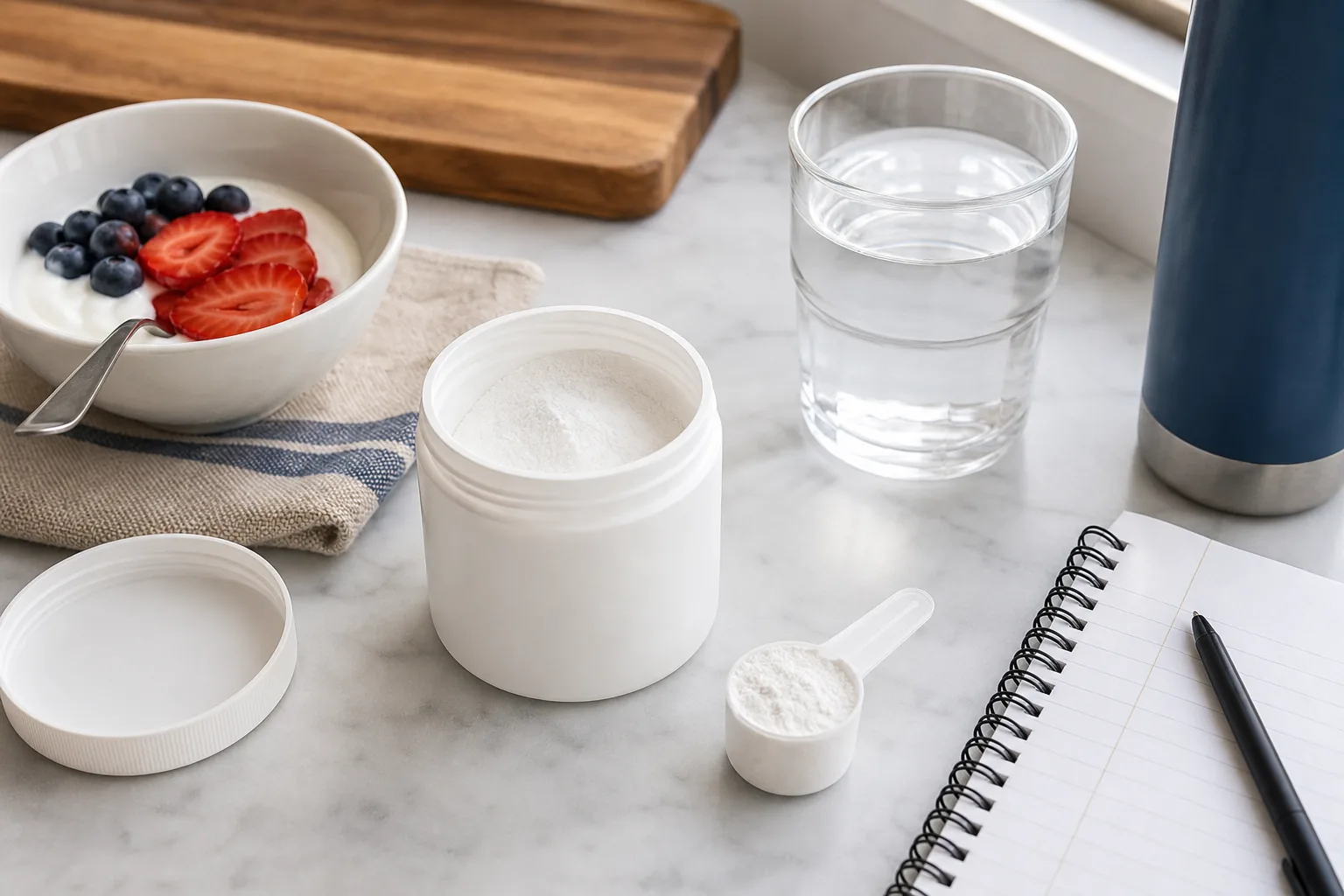
A loading phase—often about 20 grams daily divided into four smaller servings for five to seven days—can saturate muscle faster. It is optional. Taking 3–5 grams daily reaches the same destination more gradually and tends to reduce the chance of stomach discomfort.
| Approach | Typical method | Advantages | Considerations |
|---|---|---|---|
| No loading | 3–5 g daily | Simple and usually well tolerated | Saturation takes several weeks |
| Loading | 20 g daily split into 4 doses for 5–7 days, then 3–5 g daily | Faster saturation | More likely to cause temporary stomach upset or rapid water-weight change |
Which Type of Creatine Is Best?
Creatine monohydrate remains the first choice because it is the form used in most research. More expensive versions—buffered creatine, creatine hydrochloride, “advanced absorption” blends and gummies—have not consistently shown superior results.
Choose a product that lists creatine monohydrate as the only active ingredient and, where possible, has independent third-party testing for identity and contaminants. Supplements are not regulated in the same way as medicines, so manufacturing quality matters. Avoid proprietary blends that hide the actual dose.
Does Creatine Cause Weight Gain or Bloating?
A small increase on the scale is common, especially during loading. Creatine draws water into muscle cells, and this can increase body weight without increasing body fat. Some people notice no meaningful change; others see approximately one or two kilograms, depending on body size, dose, diet and baseline creatine stores.
If rapid scale changes feel uncomfortable, skip the loading phase and use 3 grams daily. Persistent swelling, unusual shortness of breath or symptoms that do not fit normal training adaptation should not be dismissed as “just creatine”; seek medical advice.
Safety, Side Effects and Who Should Ask a Doctor First
Creatine monohydrate has a strong safety record in healthy adults when used at standard doses. Possible side effects include stomach discomfort, loose stools or cramping, particularly when large servings are taken at once. Splitting the dose or taking it with food can help.
Speak with a clinician before using creatine if you:
- have kidney disease or abnormal kidney-function tests;
- are pregnant, planning pregnancy or breastfeeding;
- take medicines that may affect kidney function or fluid balance;
- have a complex chronic medical condition;
- are under 18;
- are preparing for blood tests and need help interpreting creatinine results.
Creatine supplementation can raise blood creatinine because creatinine is a breakdown product of creatine. This does not automatically mean kidney damage, but it can complicate interpretation. Tell your healthcare professional what you take so they can choose and interpret tests appropriately.
Seven Common Creatine Myths
- “Creatine is a steroid.” False. It is not an anabolic steroid or hormone.
- “It only works for men.” False. Women can also increase muscle creatine stores and may benefit from improved training capacity.
- “It automatically makes you bulky.” False. Major muscle gain requires sustained training and adequate nutrition.
- “You must cycle it.” There is no established need for healthy adults to cycle standard-dose creatine.
- “You must take it immediately after training.” Consistency matters more than a narrow timing window.
- “All weight gain is fat.” False. Early change is usually water stored within muscle.
- “More is always better.” False. Once muscle stores are saturated, excessive doses add cost and may increase digestive problems.
A Practical Four-Week Starter Plan
If you are a healthy adult and have decided that creatine is appropriate, keep the experiment simple:
- Week 1: take 3 grams of creatine monohydrate daily with breakfast or lunch. Record body weight only if it is useful rather than stressful.
- Week 2: continue daily. Complete two or three full-body strength sessions using movements such as squats to a chair, rows, presses, hip hinges and carries.
- Week 3: progress one variable—an extra repetition, a small weight increase or an additional set—while maintaining good technique.
- Week 4: review tolerance, consistency and training performance. Do not judge the supplement only by scale weight or a dramatic sensation.
Continue to prioritise enough total energy, protein distributed across meals, fruit and vegetables, fibre, fluids and sleep. Supplements should make a good routine easier to support, not distract from it.
Frequently Asked Questions
Can women take creatine every day?
Most healthy adult women who use creatine take it daily, including rest days. Consistency maintains muscle creatine stores. Medical circumstances can change whether daily use is appropriate.
Is creatine useful without exercise?
Some non-exercise research is emerging, particularly around cognition and ageing, but the clearest practical benefits occur with resistance or high-intensity training.
Should I take creatine before or after a workout?
Either can work. Choose a time that supports daily adherence. Taking it with a regular meal is convenient for many people.
Can vegetarians benefit more?
Vegetarians and vegans often consume less dietary creatine and may begin with lower muscle stores. Some may experience a larger increase in stored creatine, although individual response still varies.
Does creatine cause hair loss?
Current evidence does not establish that creatine causes hair loss. Concern largely comes from one small study that measured a hormone marker rather than actual hair loss. People with symptoms should discuss them with a qualified clinician instead of assuming a supplement is the cause.
The Bottom Line
Creatine monohydrate is one of the best-researched sports supplements and deserves a more nuanced reputation than “bodybuilding powder.” For women, its most convincing use is to support strength and high-intensity training. It may be especially relevant when preserving muscle becomes a priority, but claims about bone density, mood, menopause symptoms and brain health should remain cautious.
A daily 3–5 gram dose, no mandatory loading phase and a reputable monohydrate product are sensible basics for healthy adults who choose to use it. Combine it with progressive resistance training, adequate protein and recovery. If you have a medical condition, take relevant medication, are pregnant or are unsure, ask a healthcare professional who knows your history.
Sources and Further Reading
- NIH Office of Dietary Supplements: Exercise and Athletic Performance Supplements
- International Society of Sports Nutrition: Nutritional Concerns of the Female Athlete
- ISSN Position Stand: Safety and Efficacy of Creatine Supplementation
- 2024 Systematic Review and Meta-analysis: Creatine and Cognitive Function
- NCCIH: Bodybuilding and Performance-Enhancement Supplements
Medical disclaimer: This article is for general education and does not diagnose, treat or replace personalised medical advice.